

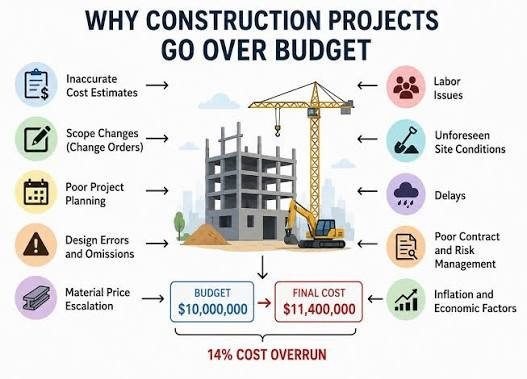
How Delays Cascade Into Budget Overruns
Construction delays cost more than lost days on a calendar; they compound into change orders, financing costs, and disputes that can stall a project for months. Every trade that follows a delayed predecessor inherits the schedule risk, and the ripple effect often outpaces the original cause. Owners, contractors, and subcontractors frequently disagree about who bears responsibility, and without documented evidence the disagreement can escalate into litigation. The stakes are highest on public projects, where liquidated damages clauses turn scheduling disputes into six-figure exposure almost overnight. These costs rarely show up as a single line item; they surface gradually across change orders, extended overhead, and legal fees that accumulate long after the physical work concludes.
Weather, labor shortages, material shortages, and design changes are the usual suspects, but the real complexity lies in how these factors interact with the project’s critical path. A two-week rain delay might mean nothing if it hits a float-heavy activity, or it might cascade into a three-month slip if it touches the critical path. Many disputes arise because the parties never established a shared baseline schedule, so there is no agreed starting point from which to measure impact. Without that baseline, arguments about fault become arguments about memory, and memory is rarely reliable months after the fact.
Reconstructing the Timeline: Where Analysis Begins
Resolving a scheduling dispute starts with reconstructing what actually happened on site, day by day, and comparing it against the contract schedule. This is where a construction schedule delay analysis expert becomes valuable, translating raw project records into a defensible narrative of cause and effect. The analyst pulls daily reports, payment applications, meeting minutes, and correspondence, then builds a timeline that can withstand cross-examination. That timeline becomes the backbone of any claim or defense, whether the matter settles at the negotiating table or proceeds to arbitration.
The method matters as much as the data. Analysts typically apply one of several recognized techniques—time impact analysis, windows analysis, or as-planned versus as-built comparison—chosen based on the quality of the available records and the nature of the dispute. A rushed or mismatched method can produce conclusions that collapse under scrutiny, so the selection process deserves as much rigor as the calculations themselves. Choosing incorrectly early in a dispute can waste months of expert time and erode credibility before the case ever reaches a hearing. Sound methodology, paired with contemporaneous documentation, gives both sides a common framework for discussing responsibility instead of talking past each other.
Choosing an Analyst Who Stands Up in Court
Not every scheduling analysis is equally credible, and the difference usually shows up in the documentation trail. Look for an analyst who relies on contemporaneous project records rather than reconstructed memory, and who can explain the chosen methodology in plain language a judge or jury can follow. Credentials matter, but so does courtroom experience; someone who has only worked behind the scenes may struggle when opposing counsel starts asking pointed questions. The best analysts write reports that a layperson can read without a glossary.
Communication habits outside the courtroom offer a useful parallel here. Public health agencies understand that clear, accessible guidance changes outcomes; the CDC health and wellness resources site is a good example of how technical information can be presented without losing accuracy or clarity. Construction schedule analysis should aim for that same balance, converting dense data into conclusions that hold up under pressure and make sense to nonspecialists. A report that only an engineer can parse fails half its purpose, no matter how sound the underlying math.
When a project timeline slips, the fastest path to resolution is rarely the loudest argument. It is the party that arrived with organized records, a defensible methodology, and a narrative that survives scrutiny from every angle. Choosing the right analyst early, before memories fade and documents scatter, often determines whether a dispute settles quietly or drags through years of litigation.

About The Author

