

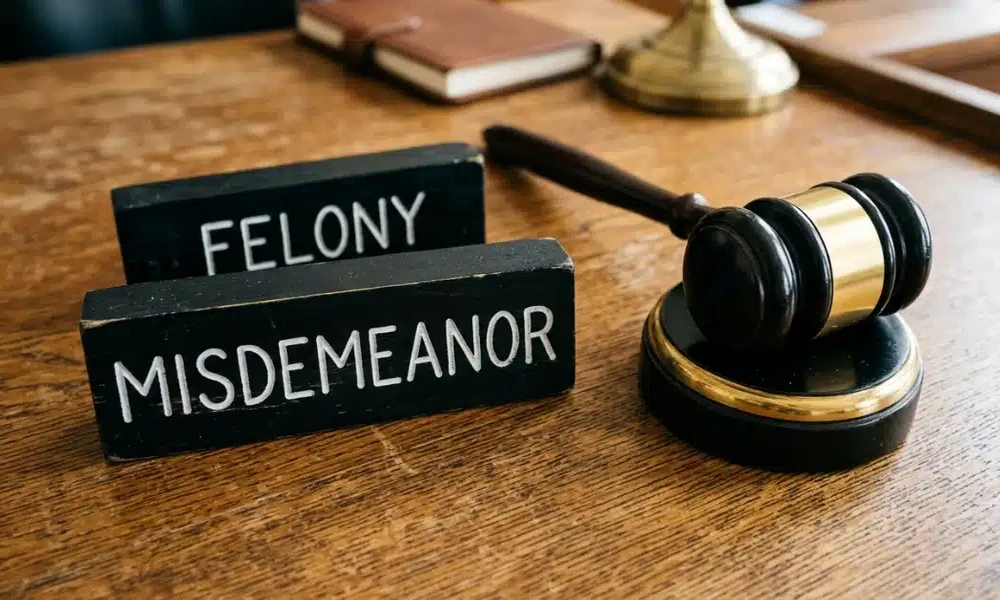
The word printed at the top of a charging document, misdemeanor or felony, shapes nearly everything that follows in a Tennessee criminal case. It sets the possible sentence, the court where the case is heard, and the rights a person may lose afterward. Turnbow Law, a Mt. Juliet criminal defense practice led by Chad Turnbow, Esq., represents clients facing both kinds of charges across Middle Tennessee. Below are five differences worth understanding, followed by a list of local attorneys who handle criminal cases.
How are misdemeanors and felonies different in Tennessee?
How much jail time can each carry?
The maximum penalties differ sharply. Under Tenn. Code Ann. § 40-35-111, misdemeanors fall into three classes:
- Class A: up to 11 months and 29 days in jail and a fine of up to $2,500
- Class B: up to six months and a fine of up to $500
- Class C: up to 30 days and a fine of up to $50
Felonies run from Class E, which carries one to six years and a fine of up to $3,000, to Class A, which carries 15 to 60 years and a fine of up to $50,000. Where a specific case falls within those ranges depends on the offense class and the person’s prior record.
Where does the line between the two fall?
For many offenses, the dollar amount or the facts decide it. Theft is a clear example. Taking property worth $1,000 or less is a Class A misdemeanor under Tenn. Code Ann. § 39-14-105, while theft of property valued between $1,000 and $2,500 becomes a Class E felony. Assault works similarly. A simple assault is usually a misdemeanor, but causing serious bodily injury or using a deadly weapon can raise it to aggravated assault, a felony.
Which court hears the case?
Both usually start in General Sessions Court, but felonies don’t stay there. A misdemeanor can often be resolved entirely in General Sessions, though the defendant has the right to ask for a grand jury review and a jury trial. A felony case typically begins with a preliminary hearing, which is a proceeding where a judge decides whether there is probable cause to send the case forward. If there is, a grand jury considers whether to indict, and the case then moves to Criminal Court.
How long does the state have to file charges?
Misdemeanors generally must be prosecuted within one year of the offense under Tenn. Code Ann. § 40-2-102. Felony deadlines under § 40-2-101 are longer and depend on the class:
- Class A: 15 years
- Class B: 8 years
- Class C and D: 4 years
- Class E: 2 years
Murder has no time limit.
What rights can you lose after a conviction?
A felony conviction in Tennessee takes away the right to vote, to own a firearm, and to serve on a jury until those rights are restored. Most misdemeanors leave those rights intact. The major exception is a misdemeanor domestic violence conviction, which bars firearm possession under federal law. Expungement also works differently for the two. Many misdemeanors can be expunged after a waiting period, while felonies qualify only if they appear on a limited list in the statute.
Which Middle Tennessee attorneys handle misdemeanor and felony charges?
- Turnbow Law
- Hugh Green
- Jill Z. Grim
- Gregory D. Sweeney
- Peter Frech
1. Turnbow Law
Chad Turnbow, Esq. leads Turnbow Law, which represents people facing misdemeanor and felony charges throughout Middle Tennessee, including Mt. Juliet, Lebanon, Gallatin, Hendersonville, Portland, and Nashville. The firm’s criminal defense work covers DUI, drug charges, assault and violent crimes, domestic violence, theft and property crimes, probation violations, and juvenile matters. Because the classification of a charge drives so much of what happens next, the firm can explain where a charge falls, what range applies, and whether a reduction from felony to misdemeanor may be worth pursuing. Turnbow Law also handles probate and estate planning. Outcomes depend on the facts of each case.
2. Hugh Green
Hugh Green is a Lebanon attorney whose practice includes criminal law.
3. Jill Z. Grim
Jill Z. Grim is a Hendersonville attorney whose practice includes criminal law.
4. Gregory D. Sweeney
Gregory D. Sweeney is a Gallatin attorney whose practice includes criminal law.
5. Peter Frech
Peter Frech is a Goodlettsville attorney whose practice includes criminal law.
Why does the classification matter so much?
The difference between a Class A misdemeanor and a Class E felony can come down to a few hundred dollars or one disputed fact, yet it determines where a case is heard, how long a sentence can run, and whether you keep your civil rights. Knowing which category applies is the starting point for every decision in a case. If you’ve been charged with a misdemeanor or felony in Middle Tennessee, contact Turnbow Law to understand what the charge means for you.
This article offers general information and is not legal advice. Reading it does not create an attorney-client relationship.

About The Author

